The i.MX RT1060 EVK uses the i.MX RT1060 crossover MCU, running at 600 MHz featuring NXP's advanced implementation of the ARM Cortex-M7 core. The 1 MB on-chip RAM, PXP GPU, and extensive external memory options make this board ideal for UI applications. Support for FreeRTOS is available within the MCUXpresso SDK. The i.MX RT1060 EVK board is supported by ARM Mbed OS and Zephyr OS, both open-source embedded operating systems for developing the Internet of Things.
NXP i.MX RT1060 EVK LVGL Demo
The i.MX RT1060 EVK earned Standard LVGL board certification, which means users can be sure that it's easy to use this board with LVGL and they can expect decent performance and quality.

Buy now#
The i.MX RT1060 EVK board can be purchased directly from NXP or its distributors. See the NXP product page for purchasing options.
Specification#
Display Details#
- Resolution 480x272
- Display size 4.3"
- Color depth 16 bit, RGB565
- Technology TN
- DPI 128 px/inch
- Touch pad Resistive
- Brightness 350 cd/m²
- Interface RGB
Power Supply#
USB mini (5V)
Performance#
Frame Rate (FPS)#
The MCU's 600 MHz clock speed and ARM Cortex-M7 architecture are abundantly sufficient for the 480x272 display to create state-of-the-art UIs with image transformations, animations, opacity, and numerous assets. The i.MX RT1060 has a PXP GPU with built-in LVGL support that can be simply enabled in lv_conf.h.
The MCU is equipped with an LCD controller to drive the display directly. Multiple frame buffers can be added to the board's external RAM, and you can even add two to the MCU's internal RAM. From the frame buffer(s), the MCU automatically sends the current frame to the display.
The LCD controller supports maximum 1366x768 resolution, which is about 8 times larger than the board's 480x272 display. The relation is not fully linear, but if the UI has—for example—50 FPS with 25% CPU usage on 480x272, it will have approximately 25 FPS with 100% CPU usage on 1366x768.
The board reached 32 FPS on LVGL's certification benchmark. In the video you can see that even the most complex transformations or scrolling the whole screen with all the animations were smooth. The benchmark used the display driver from the MCUXpresso SDK as it is.
The default LVGL example uses the QSPI flash of the i.MX RT1060 EVK. The other i.MX boards (1050 and 1064) use the Hyper Flash, which is much faster. That's why this board performs slightly worse.
The driver uses 2 frame buffers located in the external RAM. This is not the fastest solution because accessing the external RAM takes more time than accessing the internal RAM. Using a smaller draw buffer in internal RAM (where LVGL renders) and copying it to an external RAM framebuffer once is much faster. Alternatively, the 1 MB SRAM can be enough to store 2 frame buffers directly.
Memory#
The i.MX RT1060 chip has plenty of internal memory (1 MB RAM) and external memory (32 MB SDRAM and 2 types of external flash) as well. Let's see what graphics configurations can work with these memories.
Only Internal RAM#
The 1 MB internal RAM can be used to store even 2 whole frame buffers: 480 × 272 × 16bit × 2 frame buffers = 510 kB. This is amazing because framebuffers are usually stored in external SRAM, which is much slower than the internal RAM. This way, there's no need for other draw buffers for LVGL, and LVGL can render directly to the inactive framebuffer.
Frame Buffers in External RAM#
If more internal RAM is required or a larger screen is used, the large external RAM makes it possible to store 2 frame buffers and handle VSYNC (swap the frame buffers at the moment when the display is not being refreshed). The draw buffers of LVGL should still be stored in internal RAM because:
- They are small and can fit easily into internal RAM
- They are read/written many times per pixel, so it's important to keep memory access fast
Storing Assets#
Images and fonts can be stored in 4 kinds of memories:
- Hyper Flash: fast, non-volatile, and large
- QSPI Flash: slower, non-volatile, and middle-sized
- SD card: the slowest but can have a huge size
- External RAM: fast, volatile, and middle-sized. If there are performance issues due to memory bandwidth, it's possible to load the assets from the SD card or external flash here during initialization.
Quality#
Display#
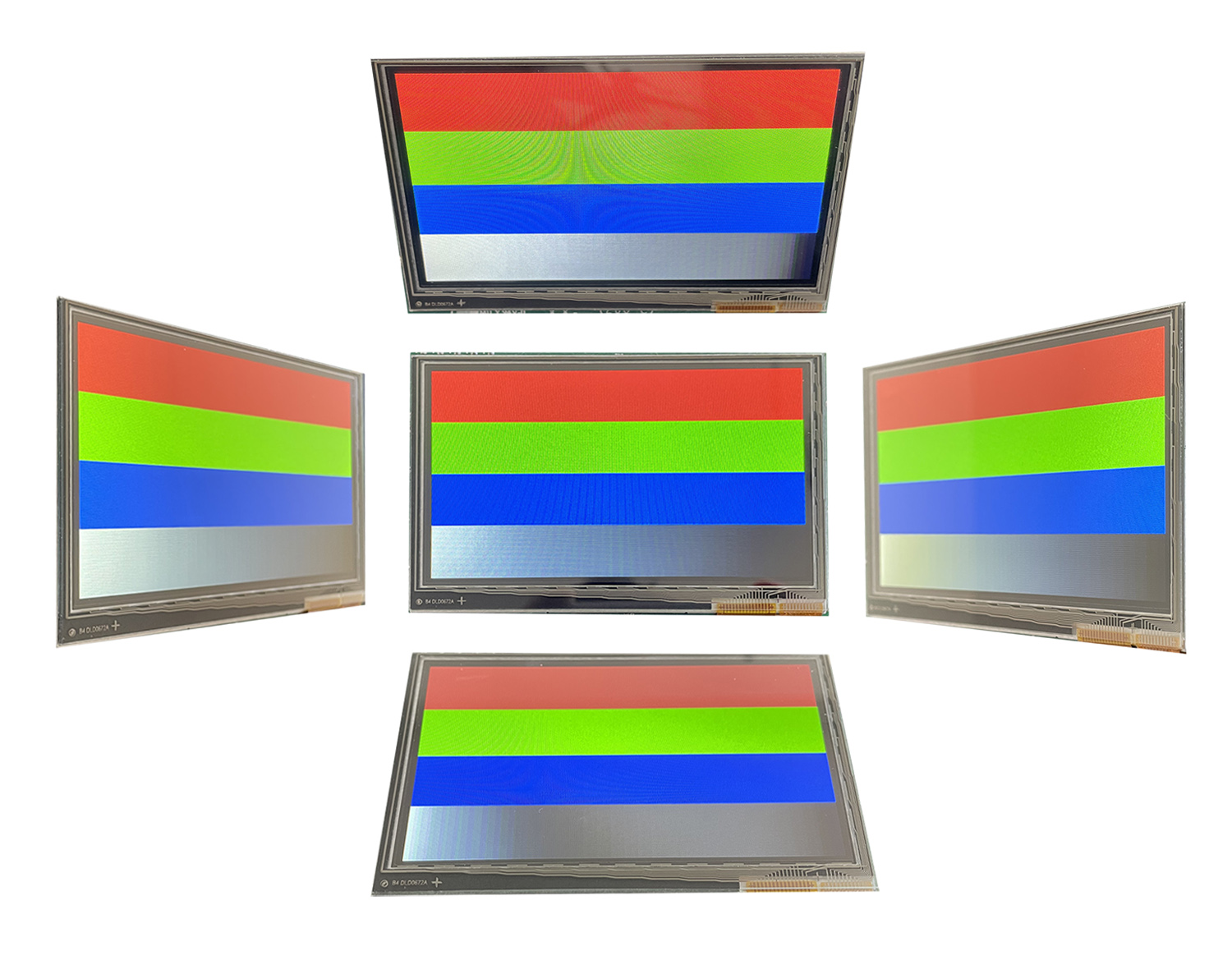
The display is built with TN technology, so its viewing angle and color correctness are only average.
Touchpad#
The i.MX RT1060-EVK is built with a resistive touchpad. Therefore, it recognizes touch with a pen or in gloves. On the other hand, customers might be accustomed to the capacitive touchpads found in smartphones.
Robustness#
The i.MX RT1060-EVK is a development board for evaluation and is not designed to be added to an end product. Although there are holes to mount the board, the display is not glued to the board.
For real-life applications, a secondary board might be required for sensors or other peripherals.
The schematic of the board is publicly available and can be a good starting point to develop your custom board based on the i.MX RT1060 EVK.
Development#
You can start to work with the i.MX RT1060 EVK in many IDEs including MCUXpresso, Keil, or IAR.
MBed OS and Zephyr also support this board. To get started with MBed OS and Zephyr, you can use their default IDE or tools, or you can use PlatformIO as well.
Of course, NXP's MCUXpresso supports this board with plenty of ready-to-use examples and applications (including UI applications with LVGL).
The board is equipped with a programmer/debugger, so all you need to do is connect the USB cable and hit the Run or Debug buttons. We have tested the board with MCUXpresso, and the debug experience was very smooth. The usual debug features of Eclipse were working well.
GUI Guider—a free UI Editor from NXP based on LVGL—also supports the i.MX RT1060 EVK board. You only need to download and install GUI Guider, select the i.MX RT1060 EVK board, create your UI, and flash it to the board with a few clicks.
Conclusion#
The i.MX RT1060 EVK is built with the extremely powerful i.MX RT1060 MCU. The 600 MHz clock speed, the PXP GPU, and the abundant internal memory make it a perfect choice to create eye-catching user interfaces without any compromises.
Due to the many examples in MCUXpresso, the wide variety of development environments, and the publicly available schematic, the i.MX RT1060 EVK is an amazing product to get started with UI development.