The gen4 – ESP32 series of modules designed and manufactured by 4D Systems range from 2.4" to 3.5" display sizes with resolutions from 240x320 to 320x480, offering an SPI interface between the screen and the ESP32-S3R8 processor. Available in non-touch, capacitive touch, and capacitive touch with cover lens bezel (CLB). The ESP32-S3R8 processor makes available multiple GPIO which include UART, SPI, I2C, PWM, and analog functionality, while also serving interfaces for the LCD touch screen, Quad SPI flash, microSD card, and native USB-C. The user interface to the gen4-ESP32 series is a 30-pin FPC/ZIF socket, designed for a 30-way 0.5mm pitch FFC cable, for easy and simple connection to an application or motherboard, or for connecting to accessory boards for a range of functionality advancements.
4D Systems gen4-ESP32-32CT LVGL Demo
The 4D Systems gen4-ESP32-32CT board earned Standard LVGL board certification which means users can use it to create a graphical user interface with LVGL, albeit with some limitations.

Buy now#
You can purchase the 4D Systems gen4-ESP32-32CT board directly from the manufacturer. Check it out here.
Specification#
CPU and Memory Details#
- SoC ESP32-S3R8 (dual-core Xtensa, up to 240 MHz)
- RAM 512 KB SRAM (internal) + 8 MB Octal SPI PSRAM (external)
- ROM 384 KB ROM (internal)
- Flash 16 MB Quad SPI NOR flash (external, XIP)
- GPU none
Display Details#
- Part number Gen4-ESP32-xx
- Resolution 240x320
- Display size 3.2"
- Interface SPI
- Color depth 16-bit RGB565
- Technology TN
- Brightness 190 nit
- Touch pad Capacitive
Performance#
The ESP32-S3 is a high performance microcontroller with two Xtensa RISC cores running at up to 240 MHz. It has decent graphics performance even without a dedicated GPU. The display is connected via SPI, which is adequate for lower resolutions and mostly static screens, however, it may struggle with full screen refresh or full screen scrolling. Since the internal SRAM is not enough for a full framebuffer, a partial buffer was used in the measurement.
The display does not use TE (VSync) synchronization, which may cause visible artifacts (tearing) during refresh (e.g., in the colored screen, colored rectangles tests). This is especially prominent in landscape mode, because it is different from the physical orientation (scan direction) of the screen.
Frame Rate (FPS)#
Since the release of LVGL v9 in February 2024 we use the "Benchmark Demo" test for board certification instead of the "Music Demo". This is a suite of various basic widget tests. This benchmark gives a more in-depth view of the performance of individual widgets than the Music Demo. Please note that this benchmark depends heavily on the resolution of the screen, so comparing different displays only by looking at the FPS may be misleading.
Using the 9.0.1 release of LVGL we have measured an average of 24 FPS with this board. The Widget Demo test ran at 18 FPS. The most difficult tests are the "Rotated ARGB images", which ran at 10 FPS, and the "Screen sized text", which ran at 15 FPS.
Memory#
The board has 8 MB Octal SPI PSRAM, which can be used for even a full screen sized framebuffer. It makes also possible to pre-render some complex widgets (e.g., charts, gauges) into the memory for faster refresh.
Quality#
Display#
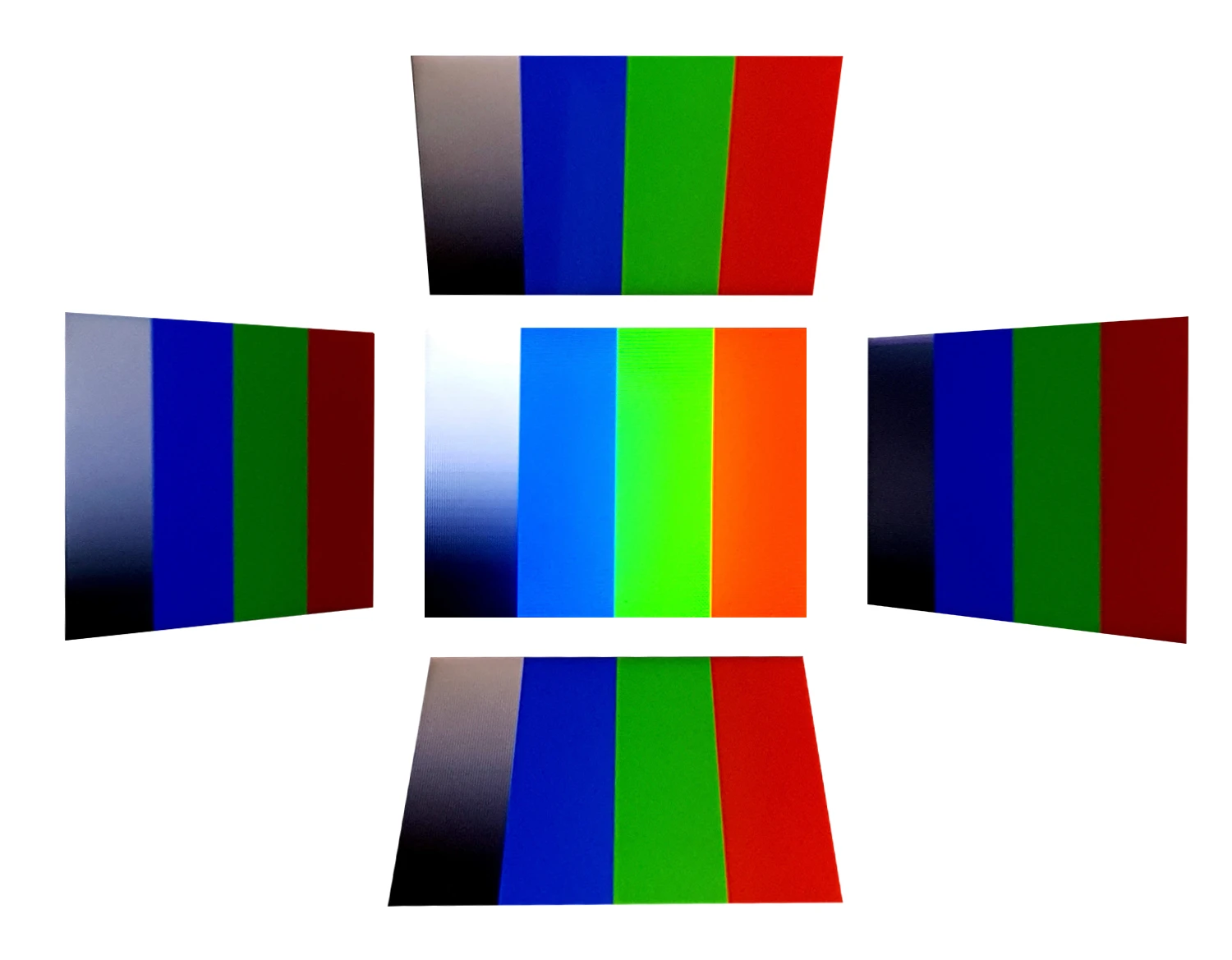
This particular board uses a TN display with rather low brightness, therefore the viewing angles are somewhat limited, and the colors are a bit off. There is also a strange artifact apparent with moving items, which results in an "interlaced" look. This may be related to the particular refresh rate set by the driver.
Touchpad#
The 4D Systems gen4-ESP32-32CT board comes with a quite responsive capacitive touch screen. During our evaluation the touch screen was very accurate and we haven't found any issues with it.
Robustness#
This board looks impressive with the tiny SMD components. It has a solid frame made of plastic, which includes mounting holes as well. Overall it seems to be robust even for industrial applications.
Development#
4D Systems provides their own IDE for their HMI products called Workshop 4. The IDE fully supports the ESP32-based boards with its own drag and drop style of programming environment. 4D Systems also provides a display/touch driver for Arduino.
Configuring the board in Arduino IDE was fairly easy, although the Arduino environment has a number of quirks.
It is also possible to use Espressif's ESP-IDF 5.2 framework, which is a better choice for serious development, although it has a steeper initial learning curve.
4D Systems provides a lot of useful information here.
The board can be programmed via its USB-C interface from within the Arduino IDE or from the Eclipse-based Espressif-IDE. 4D Systems also sent me a 4D-UPA universal programmer board, which can be used to program the ESP32-S3 via UART, but I did not use this. Unfortunately I did not find a JTAG connector on the board, although it would be useful for debugging, especially if the USB port was used for custom purposes.
Conclusion#
The 4D Systems gen4-ESP32-32CT board offers a relatively low-cost entry into developing a graphical user interface for a product. 4D Systems supports several development environments including Arduino and ESP-IDF.
The TN screen is OK for low-cost products, although I'd prefer an IPS screen (note that 4D Systems does offer various boards with IPS screen as well). The board has lot of GPIO pins for interfacing to external hardware. It is a solid, simple to install, nice board. The ESP32-S3 is a very capable microcontroller, which can do much more than just running the GUI.